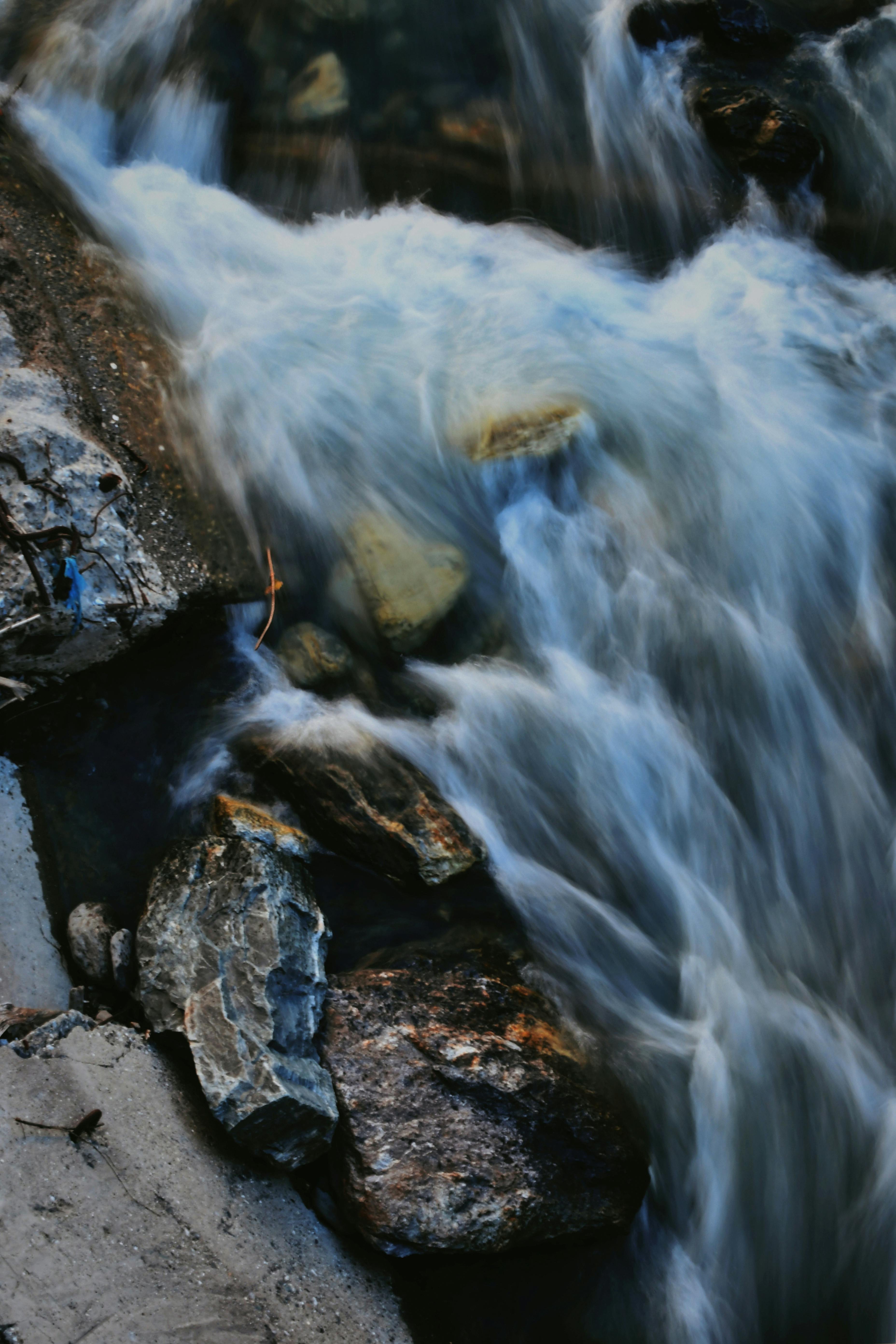
Photograph a waterfall in midday sun and the water turns to ice. The shutter is so fast that motion freezes into a single moment. To get the milky, flowing look, you need the shutter near a full second — but at that shutter speed in direct sun, the image goes white. Even closing the aperture all the way down is not enough. This is the contradiction an ND filter solves. Its full name is neutral density, and it is a piece of gray glass that subtracts a specific amount of light.
Stops are the unit that defines everything
ND filters are sorted by how many stops they cut. ND2 cuts one stop, ND4 cuts two, ND8 cuts three, ND64 cuts six, ND1000 cuts about ten. Each stop allows the shutter to double in length to keep the same exposure. ND8 turns 1/500 into 1/60. ND1000 turns 1/500 into about 2 seconds. The classic milky-waterfall photo usually wants more than a second of exposure, which is why ND1000 ends up in so many bags.
Landscape photographers typically keep three: ND8, ND64, ND1000. ND8 handles golden hour where light is changing quickly. ND1000 handles midday long exposures. ND64 sits in the middle, or stacks with another to fill gaps. Stacking adds stops. ND8 plus ND64 gives nine stops together.
Variable NDs are convenient with limits
Variable ND filters cover roughly two to eight stops in one piece of glass. The trick is two polarizers facing each other with one ring rotating. More rotation means more light cut. Convenient, but the limits are real. Near maximum rotation, an X-shaped dark cross appears in the frame as the polarizers approach perpendicular and light no longer passes evenly. The reliable working range usually sits one notch inside the advertised maximum.
On wide-angle lenses, variable NDs also tend to lose color uniformity. One side of the frame goes blue, the other shifts magenta. At anything wider than 17mm this is almost always visible. If you shoot wide regularly, a stack of fixed NDs gives cleaner results than a single variable.
NDs in motion work do a different job
In stills, ND extends the shutter for a creative effect. In motion work, ND preserves the shutter angle. For natural-looking motion blur at 24 fps, the shutter angle should stay at 180 degrees, which means 1/48 of a second. Holding that shutter outdoors at noon at f/2.8 requires an ND in the chain. Without it, the shutter climbs to 1/1000 and the footage takes on the staccato look of fast shutter video, far from the cinematic feel.
This is the awkward part for someone moving from stills to motion. The same light, the same aperture, but no ND means no usable video. The flow of working through an ND across stills and motion is touched on alongside the rest of the screen and display section. Reading those notes alongside this one clarifies why ND is non-negotiable in video work.
Long exposures shift white balance
ND filters, especially strong ones, do not subtract light perfectly evenly. The cut differs slightly between the red and the blue end of the spectrum, leaving a subtle color cast in long exposures. Budget ND1000s often shift the whole frame toward blue or magenta. Post-processing can correct it, but heavy corrections drag other colors with them. Starting with a filter that has minimal cast saves work later.
The broader context of how light color is shaped along the way is laid out in this cheat sheet on color temperature and Kelvin. An ND’s cast is just one example of color change introduced by what sits between a light source and the sensor.
Graduated NDs are a different tool
Where a plain ND uniformly subtracts from the whole frame, a graduated ND is dark on the top half and clear on the bottom. The job is to compress the dynamic range between sky and land. When the sky blows out white, slide the dark half of the graduated ND over the horizon and the sky and ground fit into one exposure. Even with HDR and digital compositing easily available, landscape photographers still carry graduated NDs because the in-camera result has a natural quality that composites struggle to match.
Graduateds come in two flavors. Hard graduateds have a sharp transition line and suit seascapes with clean horizons. Soft graduateds blend gradually and suit scenes with jagged mountain lines.
Practical notes: tripod and shutter release
Long exposures demand a tripod. Anything over a second handheld will be blurred. Setting the camera on a stable surface helps as a backup, but framing accurately becomes difficult. A wired or wireless shutter release prevents the pressing-hand vibration from reaching the camera. Mirror lock-up on DSLRs and electronic shutter on mirrorless further reduce sources of vibration. Keeping the camera still while ND does its work is half the photograph.
Filter systems: round versus square
Round NDs screw directly to the front of the lens. Convenient on one lens but inconvenient across a kit of different diameters. Step-up rings can adapt smaller lenses to a larger filter. Square filters mount through a holder, where one filter set adapts across lenses by changing adapter rings. Graduated NDs need to slide up and down to align the transition with the horizon, which is why square systems dominate for grads. For landscape-heavy work, building around a square system pays off long term.
One more detail worth understanding is how autofocus behaves through an ND. Up to about six stops, AF runs normally. Beyond that, with a ten-stop filter on, phase detection begins to wobble. Contrast detection is more robust to dim conditions but slows considerably with less light to read. The safe flow with strong NDs is to lock focus before mounting the filter, switch to manual focus, then mount the filter and shoot. Once that sequence is in your hands, working with heavy NDs stops feeling awkward.
ND filters are tools for slowing the shutter and opening the aperture, but really they are tools for handling time. Compressing the motion of a waterfall into one frame, turning night traffic into ribbons of light, maintaining natural motion blur for video. Drop in a filter and the shutter lengthens, and that longer shutter lets a single photograph hold more time. Deciding how much time to hold is the photographer’s choice.
One last housekeeping point: how to store ND filters. Tossed loose into a bag, the surfaces scratch and the coatings wear. Cloth sleeves or a dedicated filter pouch holding several at once keep the coatings alive much longer. A good ND is expensive enough that this small habit returns its cost many times over.