Autofocus is one of those camera features that everyone uses and almost no one configures past the defaults. The single button half-press, focus locks, you take the shot. This works for most subjects most of the time, which is why the system stays out of mind. The trouble starts when the subject moves, when the camera picks the wrong eye, or when low light pushes the system into hunting. At that point the autofocus modes that lived in a menu you ignored suddenly become the difference between a sharp frame and a soft one.
The basic modes have been with us since the late film era, and their names have not really changed. Single autofocus, continuous autofocus, and some flavour of automatic switching between them. What has changed, dramatically, is what each one does on a modern body.
Single autofocus and what it does well
Single autofocus, often labelled AF-S on Nikon and Sony or One Shot on Canon, runs the focus motor until it locks on whatever the chosen focus point is sitting over, then stops. The lock holds as long as you keep the shutter half-pressed. If the subject moves between the lock and the shutter release, the camera does not chase. This is exactly what you want for a static subject. It is also what you want when you intend to lock focus and recompose, since the focus distance is frozen the moment the camera confirms.
When the subject is not as still as it looks
The danger of AF-S is when the subject is not actually static. A portrait of someone sitting still is rarely as still as it looks. Breathing, micro-movements of the head, and the natural sway of an unsupported body can shift the eye by several centimetres in the half second between focus lock and shutter release. With a fast lens wide open, that is more than the depth of field, and the eye ends up soft while the ear or the collar is sharp. The fix is not always to switch modes. Often it is to lock focus, wait a beat for the subject to settle, and release the shutter immediately rather than holding the half-press for several seconds. The way the camera’s live preview behaves during this kind of fine focus check is something our notes on the rear screen cover in more detail.
Continuous autofocus and the question of trust
Continuous autofocus, AF-C or Servo, never stops focusing. As long as the shutter is half-pressed, the system tracks the focus distance under the chosen point. If the subject moves toward or away from the camera, the focus follows. This is the right mode for any moving subject. It also requires you to trust the camera’s choice of where the subject is, which is where the variations start to matter.
The basic version of continuous autofocus uses a single point you place over the subject. As long as you can keep that point over the subject, the camera holds focus. This works for predictable movement, like a child walking toward you across a flat surface, or a car approaching down a straight road. It breaks down when the subject is small, fast, or surrounded by other things the focus point might catch instead. The classic failure mode is birds in flight, where the autofocus point briefly catches a tree behind the bird, refocuses to the tree, and never recovers.
Most modern bodies offer expanded point modes that surround the chosen point with a small cluster, so if the main point drifts off the subject momentarily, the surrounding points can keep the lock. Wide area modes go further, watching a larger zone of the frame and choosing wherever the strongest subject contrast is. Some shooters live in wide area mode and never look back. Others find it picks the wrong subject too often and prefer the discipline of a small group around a known point. The right choice depends on the subject type and the kind of frame you are trying to compose, and there is no general answer that holds across every situation.
Subject detection has changed the calculation
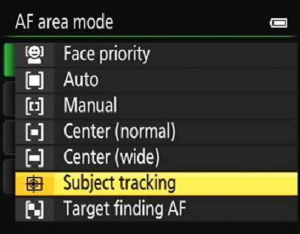
The big shift in the last few years is that cameras now know what they are looking at. Eye detection started in mirrorless bodies and is now standard, and it has expanded into face detection, animal detection, bird detection, vehicle detection, and on some bodies aeroplane and train detection. The way these work is roughly the same. The camera runs the live sensor feed through a neural network that has been trained to recognise the subject class you have selected. Once it finds a match, it places a focus point on the relevant feature, often the eye for a human or animal, and tracks that feature as it moves through the frame. A useful three-layer view of mode, area, and subject detection separates these out clearly so you can think about each axis independently.
When this works well, it is genuinely remarkable. You can frame loosely, leave the camera in continuous autofocus with subject detection enabled, and the camera will find the eye and stay on it. When it works poorly, it picks the wrong subject. With two people in a frame it may grab the wrong face. With a person facing partly away it may grab a stray nostril or an ear. With a person wearing a mask or sunglasses it may give up entirely. The system is not infallible, but it has shifted what counts as a normal shooting workflow, especially for portraits and any kind of action with predictable subject types.
The trap of mode confusion
The most common practical problem is not that any one mode is bad. It is that the photographer is in the wrong mode and does not realise it. AF-S behaves identically to AF-C until the subject moves, so a static scene gives you no information about which mode is active. A common pattern is to set AF-S for portraits at the start of a session, switch to AF-C for action partway through, and then forget to switch back. Half a minute later you are shooting a still subject in AF-C and wondering why the camera keeps refocusing slightly between frames as the subject’s pupil moves.
Most bodies offer some kind of mode dial or button that can be assigned to the AF mode, and some let you preview the current mode in the viewfinder readout. Building a habit of glancing at that readout before any new shooting situation costs almost nothing and saves you the kind of soft images that you only notice at home.
Where the focus point matters more than the mode
Even with subject detection, the camera still needs to know roughly where you want it to look. Leaving the autofocus area on the widest possible setting means the camera picks the largest detected subject anywhere in the frame, which is rarely what you want when the frame contains more than one face. A single point or a small zone over the subject focuses the system’s attention. The detection then refines from there.
The joystick advantage
This is also where the autofocus joystick on the back of most modern bodies earns its place on the body. Moving the active point with the joystick takes a fraction of a second once you are used to it, and lets you place the focus exactly where the composition needs it without recomposing. The alternative, leaving focus on the centre point and recomposing afterward, still works for AF-S, but it cannot work for AF-C since the focus distance shifts as you tilt the camera. Heavy lenses on light bodies make the joystick harder to reach with the same hand, which is part of why our notes on tripod heads matter for the kind of work where this kind of fine point placement happens often.
The reading
The honest summary is that autofocus modes are not really about the mode names any more. They are about the combination of mode, area type, and subject detection setting, and the right combination depends on what you are shooting. A portrait at f/1.4 wants single point AF-C with eye detection. A landscape wants AF-S with a small single point over the actual subject of attention, often something other than the obvious centre. Sport wants AF-C with whatever subject detection class fits the action and a focus area sized to the subject’s likely range of movement.
None of this is automatic. The body will offer reasonable defaults, and the defaults will get you a long way. But the difference between a hit rate of seventy percent and a hit rate of ninety-five percent in difficult conditions is almost always a matter of configuring the autofocus to match the situation. The advice in our notes on the different shutter modes applies in parallel, since shutter type and autofocus mode interact in continuous shooting and the wrong pairing can lose you frames in either direction. Take the time to learn what your body actually does in each mode, with the kind of subject you actually shoot. The settings are configured for you. The choice of which ones to use is not.