Ten minutes before doors open, the center aisle of the community theater looks like the obvious place for my tripod. Then the house manager points to the queue forming outside and explains that late arrivals will use that aisle throughout the first act. Onstage, a singer steps from a dim blue wash into a hard white special, and her face jumps several stops brighter on the monitor. This is the central problem behind how to film a local live performance with one camera: the best position in an empty room may fail once spectators arrive, while an exposure that suits one lighting cue may collapse during the next.
With no second angle to cover a correction, I treat the recording as a protected continuous master shot. The composition must preserve every entrance, line, song, and bow, then gain variety through a few deliberate changes whose timing I can predict. That approach works for concerts, plays, dance recitals, comedy sets, and community productions because it gives viewers a coherent perspective and gives the editor a complete performance. The camera can still move, and a high-resolution file may allow modest crops later, but reliability begins with a frame I would be willing to hold all evening.
Walk the room while there is still time to change the plan
My first conversation concerns permission and purpose. I confirm that the venue, producer, and performers approve recording, ask where a tripod is allowed, and state whether the result will remain a private archive, go to participants, appear online, or be sold. Recording approval and publication approval are separate practical questions. Audience visibility, venue policy, contracts, and the music itself may create further requirements. In the United States, the U.S. Copyright Office explains that musical works and sound recordings are separate protected works; required permissions depend on the material, intended use, agreements, applicable exceptions, and jurisdiction. This is a general planning warning rather than legal advice, so obtain the permissions your project needs before recording or publishing.
I then walk from stage to sound desk with the stage manager or someone who knows the production. I ask about running time, intermission, stage dimensions, entrances, exits, major blocking, lighting changes, quiet scenes, and expected applause. A rehearsal is ideal, yet even a run sheet and a short conversation can reveal that a dancer enters through the audience, a comedian leaves the lit area, or the finale fills the entire stage. I locate power without routing cables across traffic, identify exits and accessible paths, check audience sightlines, and ask whether the sound operator can provide an authorized feed of a suitable type and level. I also check whether the platform, balcony, or rear floor transmits footsteps to the tripod.
Before the audience enters, I complete one compact check:
- Permissions, tripod location, distribution plan, run sheet, and show duration confirmed.
- Media formatted in the camera; capacity, file segmentation, and recording limits checked.
- Tested batteries or secured external power ready; heat behavior and remaining runtime understood.
- Lens clean, notification sounds disabled, and distracting indicator lamps addressed.
- Audio cables, headphones, and an available backup recorder tested with permission.
Long recordings expose small assumptions. Some cameras stop at a duration limit, divide files, change behavior on external power, or heat sooner in high-resolution modes. I consult the exact manual and run a realistic test before the event whenever possible. Storage and power should extend beyond the advertised running time because delayed starts, speeches, and encores consume the margin quickly.
Build a camera position that can survive the whole show
From the empty room, I seek a central or modestly off-center position that sees both wings and clears seated heads. A little elevation often matters more than another meter of proximity. The tripod must stay outside exits and circulation paths, avoid blocking spectators, and let me reach the controls without standing in someone’s view. While helping at local festivals, I have repeatedly found that the theoretical centerline belongs to wheelchair access, an usher’s route, or the sound desk. Moving slightly to one side remains workable when the camera is level and the stage geometry does not become severely skewed.
A full-stage wide composition provides the greatest protection, especially for dance and ensemble blocking, although faces become small. A medium-wide frame gives expressions more weight while increasing the chance that a lateral move escapes. Tight performer coverage carries the greatest operational risk. For single-camera concert filming, I favor a versatile zoom whose wide end contains the complete active stage from the selected position. I frame the widest planned cue, then leave modest room at both edges and above standing performers. That reserve has saved recordings when a host used an unmarked entrance or musicians moved their chairs after soundcheck.
Test focal length from the actual tripod position, with likely heads or seat backs represented in the foreground. If the lens cannot contain the full active area at its wide end, the camera is too close for a dependable master. Recording 4K for 1080p delivery can create limited reframing room, subject to sensor crop, codec, storage demand, duration limits, processing load, and heat. It cannot recover action outside the frame or restore missed focus, so I choose that mode only after a sustained test confirms the camera can support it.
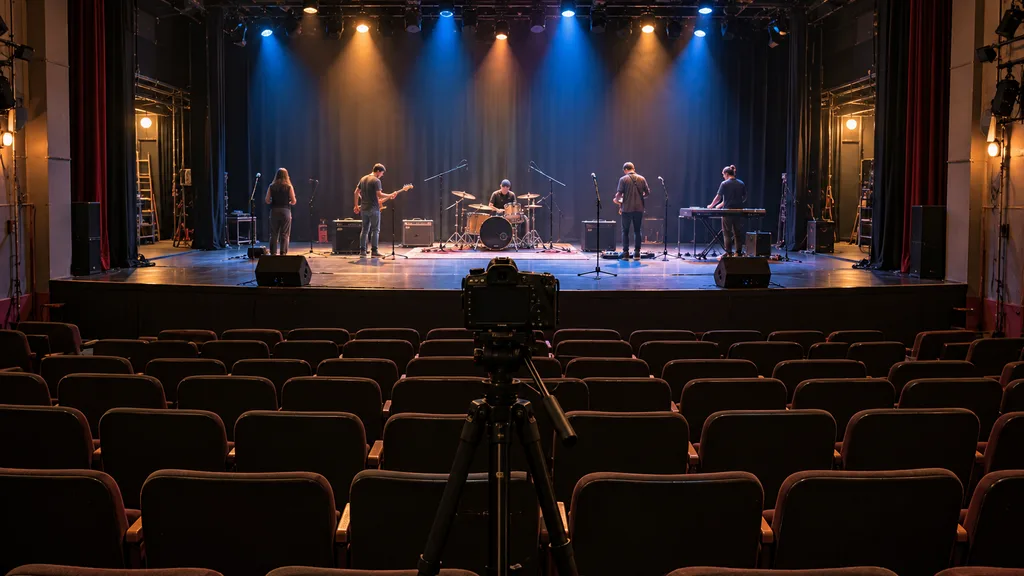
How to film a local live performance with one camera under stage lighting
During soundcheck, I choose the delivery frame rate first. Local standards, the client’s platform, and the desired motion rendering may point toward 24, 25, or 30 frames per second, among other supported choices. I then test a shutter speed near the conventional 180-degree relationship. Approximately 1/50 second can be a starting point for 24 or 25 fps, while 1/60 can suit 30 fps when the venue lighting cooperates. Canon’s introductory video setup guidance describes a shutter speed around twice the frame rate as a common approach to natural-looking motion. It remains a starting point because stage fixtures and local electrical frequency may require a different tested value.
LED stage lighting, especially when dimmed, can create flicker or horizontal bands that a quick look at the preview misses. Nikon’s camera-specific high-frequency flicker guidance documents fine shutter adjustment while inspecting the display and recommends test captures because recorded results may differ from the preview. I record the brightest cue and several dimmed colors, play each clip at normal speed, pause on suspicious areas, and inspect a larger display when one is available. Some cameras provide variable or fine shutter controls; many do not. A nearby value that reduces banding may alter motion blur slightly, so I judge the whole clip. Understanding electronic shutter behavior under stage lighting also helps, provided still-photo shutter options are not assumed to work identically during video capture.
I usually select manual exposure so the camera does not brighten an intentionally dark cue or visibly pump when a white costume crosses a black background. A tightly bounded auto ISO can be useful when cue levels exceed what one operator can manage, provided rehearsal footage proves that its transitions look acceptable. In either case, I expose for important faces and the brightest meaningful costume or prop, using zebras, a histogram, or a waveform when available. A dramatic scene should retain its intended darkness. Once a face clips to featureless white, post-production has little information to recover.
A fixed or deliberately selected white balance keeps color from wandering as the composition changes. I establish it under representative light and preserve the designed blue or amber character of later cues. Aperture balances light gathering with focus tolerance: a wide aperture helps exposure while reducing depth of field, whereas a moderate aperture gives a solo operator more latitude as performers move upstage and downstage. After shutter and aperture are established, ISO becomes the remaining exposure variable. A recorded test shows whether noise and highlight handling remain acceptable for that particular camera.
Continuous autofocus with a carefully chosen area can follow unpredictable movement, although haze, backlight, microphone stands, low contrast, and rapid lighting changes can cause hunting. When blocking is predictable and depth of field is sufficient, I may pre-focus manually on the main playing plane and verify it with magnification. Both approaches require testing. I review a clip in which a performer walks through the darkest and brightest positions because a monitor that appears sharp beside the camera may conceal brief focus errors during normal playback.
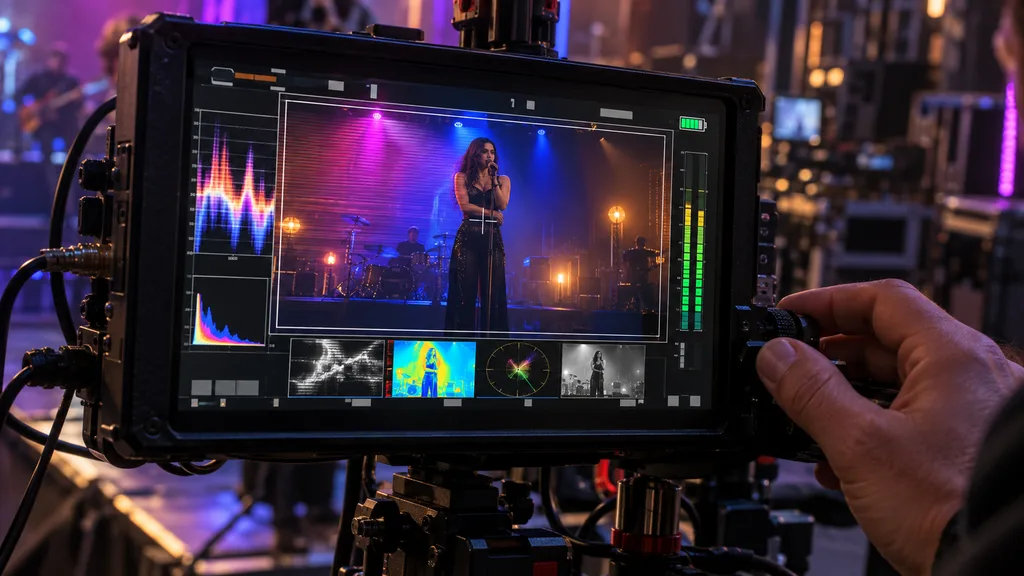
Let the performance dictate the few movements you make
When the house lights fall, I begin with the stable full-stage or medium-wide master established during soundcheck. During dialogue, choreography, a solo, or any unrepeated action, holding a slightly loose composition is usually the safest editorial choice. I use the run sheet to anticipate an entrance and begin a necessary pan before the performer reaches the frame edge, then settle gently with space in the direction of travel. Introductions, applause, blackouts, sustained musical rests, and rehearsed blocking changes offer lower-risk moments for a zoom or new composition. Each move needs a clear destination; repeated corrections make viewers feel the operator searching.
I learned this during a small showcase when I tightened on a soloist whose verse appeared self-contained. An unannounced performer entered from the opposite wing, forcing me to widen abruptly before she reached the lit center. The entrance remained in the recording by a narrow margin, while the correction attracted more attention than a steady two-shot would have. Since then, I treat tight framing as a temporary, informed decision. When I cannot identify where the next important action begins, I stay wide and let the stage direction create emphasis.
Tripod technique matters at this scale. I set enough pan and tilt drag to resist twitches while allowing a smooth follow, balance the camera, and loosen only the axes I expect to use. Lens or sensor stabilization may help with vibration on a locked shot, yet some systems drift, jump, or resist an intentional pan, so I test the exact mode. My hand rests lightly on the control, cables have slack, and I avoid shifting weight on a flexible floor. I glance at the recording indicator, remaining time, battery state, exposure warning, focus, and audio meters, then return my attention to the stage. Applause provides a useful opening for a longer status check. Staring continuously at the display can conceal an entrance occurring just beyond its edges.
Give live-performance audio its own safety margin
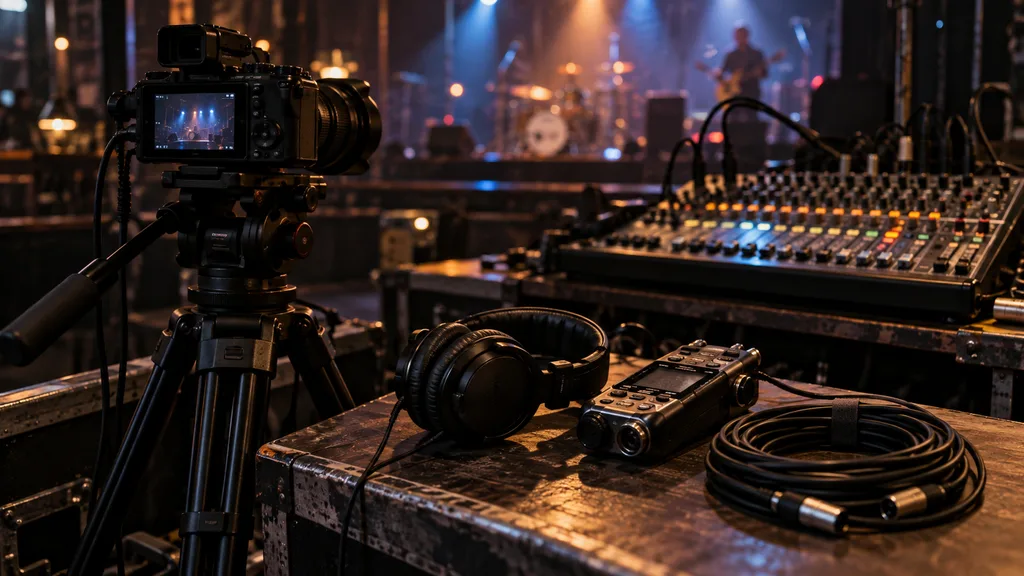
The internal microphone may document the event, yet it also captures handling, nearby conversation, autofocus noise, and a distant room-heavy balance. A camera-mounted stereo microphone can improve clarity while preserving applause. A small recorder placed at an authorized, secure location may provide a useful room perspective. An approved mixer feed can add clean vocals and instruments once the sound operator confirms the connection, signal type, and level. In a small venue, the front-of-house mix may contain little of an acoustic drum kit, guitar amplifier, or audience because those sources already fill the room. When permission, equipment, and editing time allow, a mixer feed accompanied by controlled room sound usually gives me more options.
I monitor with closed-back headphones during soundcheck and revisit them at safe moments. Room acoustics once made a loud set seem comfortable while the headphones revealed harsh overload that the small on-screen meter was easy to underestimate. Sony’s model-specific guidance advises watching the level meter and lowering the recording level for loud sources; menu names, limiter behavior, and meter scales vary, so the relevant manual governs. I leave sensible headroom for unexpected peaks and avoid clipping, which is generally unrecoverable. No universal peak number suits every device and signal chain.
For dual-system live-performance audio, I create a visible and audible sync reference before the show, keep both devices rolling when practical, and note any restart. Fresh power, sufficient media, secured cables, and placement permission remain part of the audio plan. A backup recorder helps only when it is running, correctly configured, and positioned safely.
Protect the ending and verify the files
At the final note or curtain call, I hold the composition through applause and bows. That extra time gives the edit a clean ending. Once the stage action is truly finished, I stop, confirm that the file closed correctly, and check that every expected segment appears on the card. I listen briefly to the beginning, a loud passage, and the ending; external recordings receive the same check.
Backups come before formatting. I copy the camera media and recorder files to two separate locations, verify that representative files open, and preserve the cards until both copies are secure. In the edit, I synchronize external sound, inspect exposure changes, focus, flicker, dropped frames, and clipping, then apply stabilization or reframing conservatively. Limited crops and pre-show detail shots can add variety, but they cannot reconstruct an entrance outside the frame, sustained missed focus, severe banding, or clipped audio. The clean continuous master remains the spine of the finished program.
The practical answer to how to film a local live performance with one camera is a disciplined sequence: secure recording and publication permissions, walk the venue, reserve a safe sightline, build a forgiving master frame, and test exposure, focus, flicker, heat, runtime, and sound under real conditions. During the show, move only when the action provides a predictable opening. Hold the ending, verify every file, and make two copies. One camera can preserve the full event dependably when preparation carries most of the risk and the operator’s touch remains restrained.