The word bokeh has been worn smooth from overuse. It now appears in phone marketing, software portrait modes, and any review that wants to gesture at lens quality without saying anything specific. But the original Japanese term referred to something fairly precise: the aesthetic character of the out-of-focus parts of an image, not how blurry they are. Two lenses set to identical aperture, focal length, and focus distance can render the same out-of-focus area in completely different ways. One produces highlights that look like soft glowing discs. Another produces hard-edged polygons. A third produces discs that swirl around the edges of the frame. None of these are accidents.
Where the shape comes from
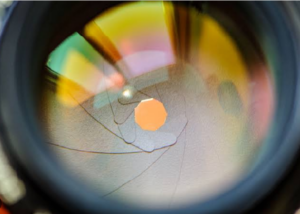
An out-of-focus point of light in the scene becomes a disc of light in the image. The shape of that disc is the shape of the aperture opening as seen from the point in question. When the lens is wide open, the aperture is essentially circular, which is the maximum size the diaphragm can reach, and out-of-focus highlights are round. As the aperture closes down, the iris diaphragm contracts, and the opening becomes a polygon whose number of sides equals the number of blades in the diaphragm. A five-bladed lens stopped down produces pentagons. A seven-bladed lens produces heptagons. An eleven-bladed lens produces a shape so close to a circle that most viewers do not register the polygon at all.
This is why aperture blade count appears in lens specifications, and why higher-end lenses tend to advertise more blades. The choice is real and affects how the lens draws an out-of-focus area, especially when you are not shooting at maximum aperture. A more thorough technical breakdown of how aperture geometry shapes background blur covers the optics in detail and is worth a read if you have ever wondered why two similar lenses can render the same scene so differently.
Blade count is not the whole story
The number of blades sets the basic polygon, but the shape of each individual blade matters as much. A diaphragm with seven curved blades produces a near-circle even at moderate apertures, while a diaphragm with seven straight blades produces a visible seven-sided polygon at the same aperture. Lens manufacturers describe these as rounded apertures, and it is now a common feature even on mid-range lenses. The decision to round the blades is a deliberate optical trade. Rounded blades produce smoother bokeh at the cost of slightly less pronounced sunstars when the lens is stopped well down, since the corners that produce the diffraction spikes get softened.
A few specialist lenses go further. The Sony STF lenses and the Fujifilm 56mm f/1.2 APD include an apodisation element, a piece of glass with a graduated neutral density coating that fades from clear at the centre to dark at the edges. The result is a bokeh disc whose brightness fades smoothly from its centre outward, so the disc has no hard edge at all. The price is a real loss of light transmission, often half a stop or more, but the rendering is unmistakable. For a deeper look at how blade count and rounding choices influence stopped-down rendering, Canon’s own technical explainer on aperture blades walks through the geometry with sample images.
What the lens design does behind the diaphragm
The aperture sets the outline. The rest of the optical system fills in the disc. This is where lenses with similar specifications start producing strikingly different looking out-of-focus areas, because the brightness distribution inside a bokeh highlight is set by the lens’s residual aberrations.
An undercorrected lens, meaning one with spherical aberration not fully removed, produces highlights that are brighter in the centre and fade toward the edges. The bokeh discs look soft and pleasant, but the in-focus image often has a slight veiling glow that some photographers describe as dreamy. Many vintage portrait lenses behave this way, and it is part of what makes them beloved.
An overcorrected lens, meaning one where spherical aberration has been pushed past zero, produces the opposite. The discs are darker in the centre with bright outer rings, a pattern photographers describe as soap bubble bokeh because the highlights look like hollow spheres. Some lenses are designed deliberately for this effect, the Meyer Trioplan being the most famous example. Others stumble into it through aggressive correction in modern designs.
A perfectly corrected lens would produce flat discs of uniform brightness. Almost no lens is perfectly corrected, since correcting one aberration usually worsens another, and lens design is a series of compromises. The character of a particular lens’s bokeh is largely a fingerprint of which compromises the designer chose.
Why bokeh discs at the edges look like cats’ eyes
At the centre of the frame the aperture looks circular when viewed from the scene. At the edges of the frame it looks like an oval or a lens shape, because the back of the lens barrel and other internal elements cut off part of the aperture’s circumference. This is called mechanical vignetting, and it makes the bokeh discs near the edges of the frame look like the iris of a cat’s eye. The effect is most pronounced on fast lenses shot wide open, since they have the largest apertures to vignette, and on wide focal lengths, where the angle to the edge of the frame is steepest.
Stopping down reduces the effect. By the time you reach f/4 or f/5.6 on most lenses, the cat’s eye shapes have rounded out into proper circles even at the corners. If you want the swirling background that some vintage lenses produce, you want a lens that does not stop the cat’s eye effect down until well past wide open. The Helios 44 is famous for this for exactly this reason.
Foreground and background bokeh are not the same
A lens can produce smooth, pleasant rendering in the background and harsh, double-edged rendering in the foreground, or the reverse. This asymmetry is a function of which side of the focal plane the out-of-focus subject sits on and how the lens corrects spherical aberration across that range. Photographers who shoot lots of close work, where there is often as much in front of the subject as behind it, learn to test both sides of the focal plane when they are evaluating a lens. A lens that draws the background beautifully but produces harsh double lines on foreground branches is a half-useful tool for that kind of work. The Wikipedia entry on bokeh collects a usable overview of the terminology and the history of how lens designers have approached the problem.
Cinema lenses are usually evaluated more carefully on both sides, since a focus pull in a moving image passes through the entire defocus range. Stills lenses have historically been judged on background bokeh alone, which is part of why some otherwise excellent stills lenses are quietly disliked by filmmakers.
How to actually evaluate it
Sample images on review sites are not enough. The way a lens renders a particular kind of background depends on what is in that background. Specular highlights, like sun on water or string lights, are the hardest test because they show the shape of the aperture clearly. A scene with mostly continuous tones, like distant foliage in even light, hides almost everything and makes most lenses look the same. If you are choosing a lens partly for its rendering, look at sample images shot against busy backgrounds with point light sources. That is where the differences show.
If you already own a lens you are curious about, a simple test setup works. Tape a row of small bright objects, even something as ordinary as a string of LED bulbs, against a dark background. Place your subject a couple of metres in front of them and focus on the subject. Shoot at maximum aperture, then at one stop down, then at two. The progression tells you how the diaphragm shapes the highlights, and whether the lens has soft or hard rendering inside the discs. If your camera has a bright EVF, you can see most of this before you even press the shutter, which speeds up the evaluation considerably. The interaction between lens choice and adapter use, which our notes on lens adapters cover, also matters when you are testing vintage glass on a modern body, since the adapter can subtly affect rendering. The earlier piece on protective filters and their optical cost is worth a glance too, since some filters affect bokeh visibly at wide apertures.
None of this tells you whether you will like a lens. Some photographers love the busy, swirling backgrounds of vintage glass. Others find them distracting and prefer the clean, neutral rendering of modern designs that hide their character carefully. There is no correct answer, only a question of fit between the lens and the kind of work you intend to do with it.